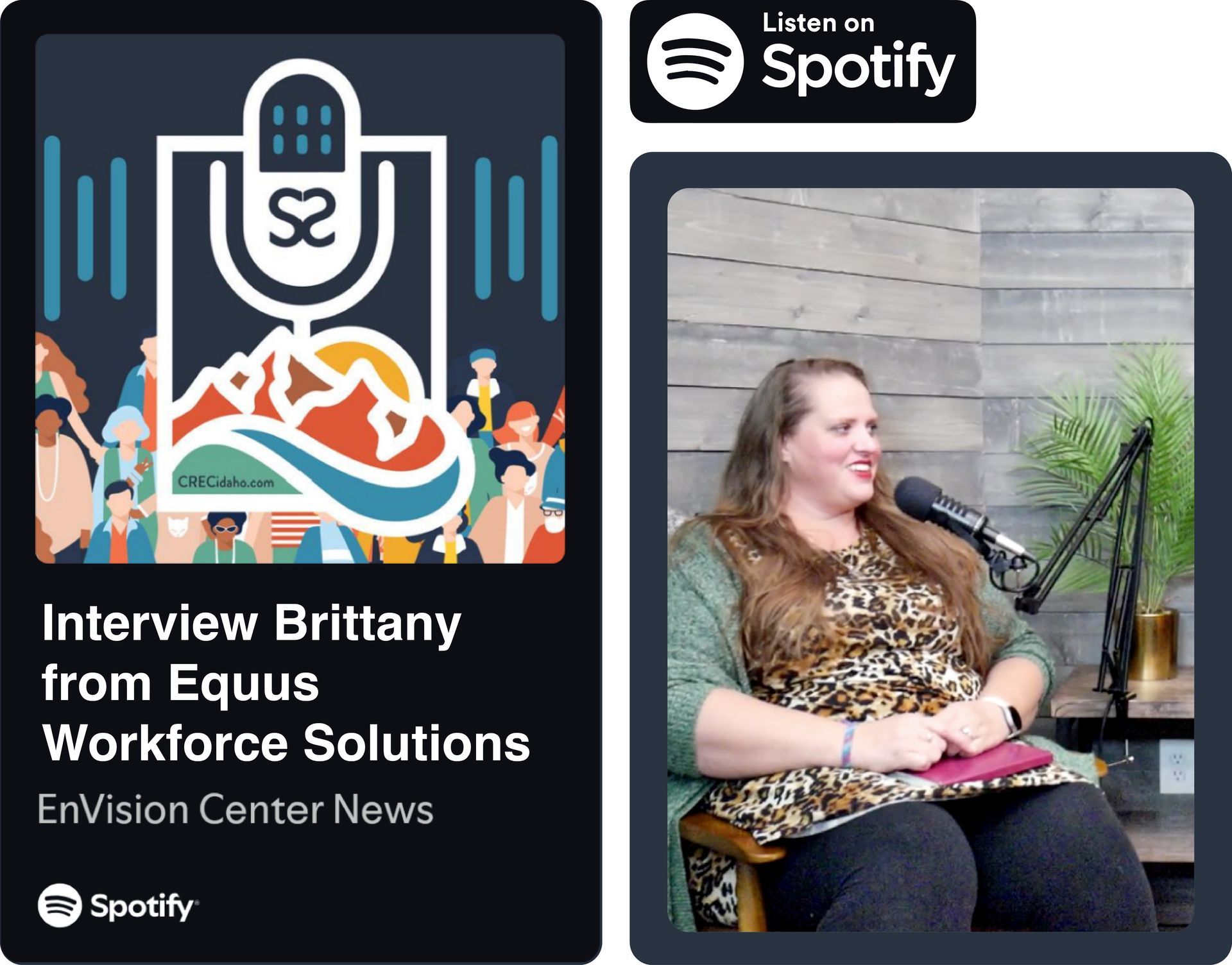
Brittany Clapp-Abdella helps people find purpose in their lives, but first she had to find hers. She’s now in a job she hadn’t expected, but once she discovered it, she knew it was the right fit. Her story is a reminder that our answer to the question “What do you want to be when you grow up?” should carry little weight in a world that’s always changing and in lives that are always growing and evolving. Brittany’s path to this work wasn’t linear. It was guided by a sense that she was made for more.
Originally from Massachusetts, she found her way to Idaho by way of family roots and an openness to start over.
“It wasn’t part of some big plan,” Brittany says with a smile. “I just knew it was time to move, and I followed where I felt led.”
When she first arrived in Idaho, Brittany started out as a private caregiver, then became a personal administrative assistant for a friend who ran a roofing company out of San Francisco. She handled operations, managing crews and logistics. What she didn’t expect was how profoundly that experience would shape her future.
“It wasn’t the job title that changed me,” she says. “It was the person I worked for.”
Her boss modeled integrity, kindness, and a work ethic that pushed her to grow. He saw her potential before she did and helped her see herself differently.
She recalled one small but meaningful moment when she and her boss were formulating a plan to get some chairs upholstered: a simple meeting where they were planning and bouncing ideas off each other. But it was during that meeting that a lightbulb went off for Brittany.
“Something clicked,” she says. “I realized I was sitting across from someone who thought like me: articulate, creative, analytical, and kind. For the first time, I saw a reflection of myself in someone I admired.”
Eventually, that boss gave her the kind of advice that is both terrifying and liberating.
“You’ve worked yourself out of a job,” he told her. “Who you are and what you’re capable of is too big for what I can offer you. You need to go do something greater.”
And so she did. Brittany took a position as an accounts manager for a roofing company. She worked hard but didn’t realize how unhappy she was. The job was unstable, offered no benefits, and the stress affected both her and her son. Brittany eventually left that job and was unemployed for about a month and a half before finding what she calls her ‘purpose work.’ It was a posting for an Outreach and Engagement Specialist with Equus Workforce Solutions (EWS).
“At first I thought it was a scam,” Brittany says. “It just sounded too good to be true.”
But when she researched the organization and found it to be a legitimate, nationally recognized career development company, she knew she had to apply.
Within 24 hours of her first interview, she was invited to meet with the regional director for the state of Idaho. During that conversation, she was asked a question that stopped her in her tracks: “When you think about this position, how do you see yourself within it?”
“I saw this image in my head, a glowing neon sign that lit up with the words Hope Dealer. I saw it flash not once but twice. At first I thought, ‘I probably shouldn’t say that.’ But then I did. I said, ‘I can see myself in this position as a hope dealer.’”
The director smiled and said, “That’s exactly it.”
That phrase, hope dealer, has become Brittany’s mantra.
“Being a hope dealer means holding out a light for someone who’s standing in the dark,” she explains. “It means saying, ‘I’ve been where you are, and I believe you can make it too.’”
That belief guides everything she does at EWS. The organization helps people remove barriers to employment and build meaningful, sustainable careers. Participants include veterans, individuals reentering the community after incarceration, people who have been laid off, single parents, and others trying to find their footing again.
Sometimes the obstacles are educational, like needing a GED to qualify for better jobs. EWS covers testing fees and even offers financial incentives for every test passed. Other times, the barriers are financial or practical, like paying for a commercial driver’s license or buying work gear. And the support doesn’t stop there. Participants can also get help preparing for interviews, or writing resumes. By working with other organizations such as Idaho Launch, tuition, testing, books, and supplies are often fully covered.
“When a person gets a job that fits them, it changes everything. It changes their sense of self, their family, their community,” says Brittany.
She’s quick to add that she’s walked many of the same paths her participants are on.
“I know what it feels like to start over, to wonder if you’re enough, to need someone to say, ‘You can do this,’” Brittany says. “And that’s exactly what we do every single day.”
Take the first step. Visit equusidaho.com and click “Apply Now.”
It only takes a few minutes to get connected with a career coach who can help you move forward. Not looking yourself? Pass it on. Empowered people empower people.